 TR
TR
 EN
EN
Master Controller
Master Controller
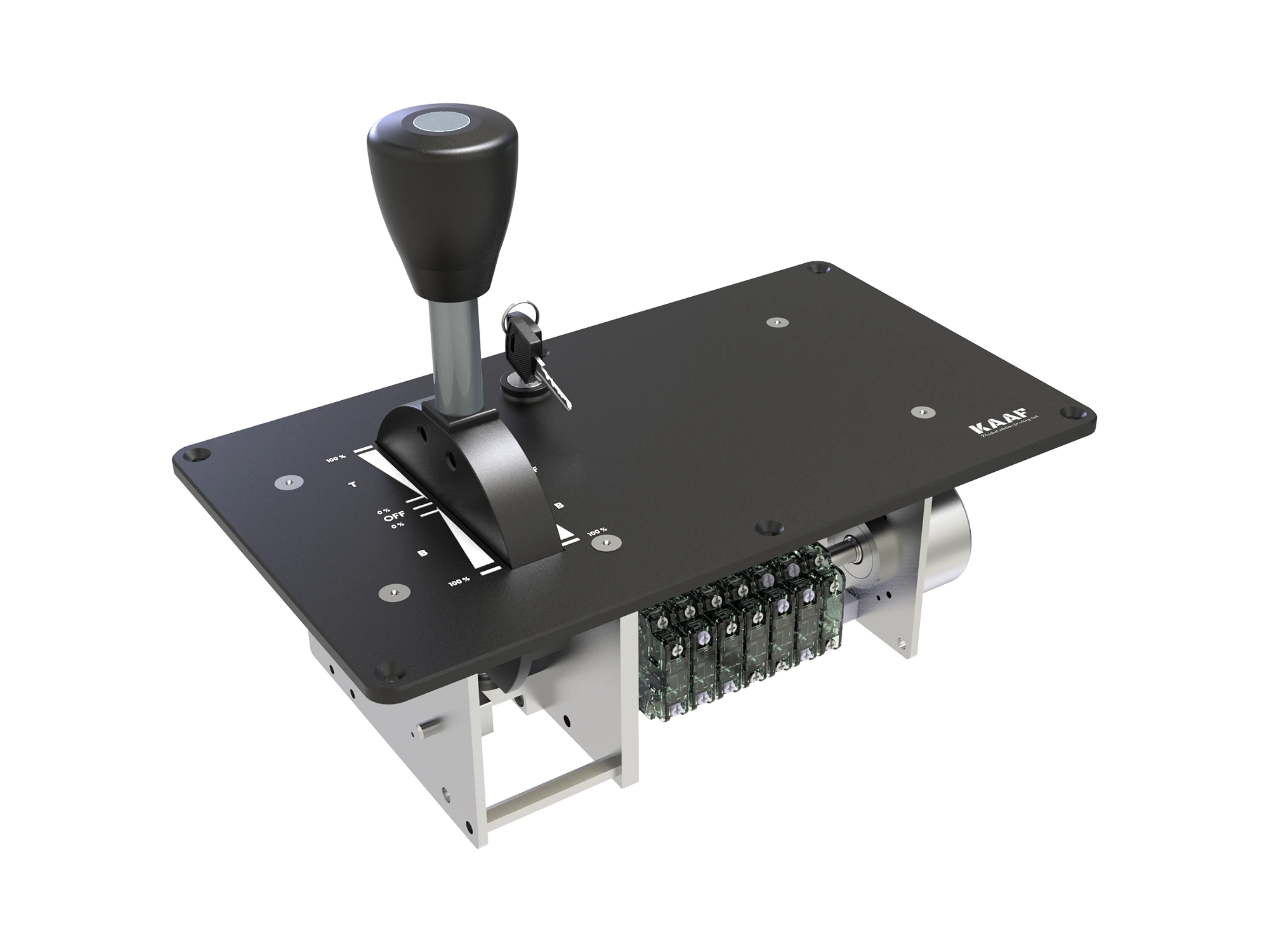
What is a Master Controller?
The master controller allows precise control of the train's movement, acceleration, and braking. With this device, the driver can move or stop the rolling stock efficiently.
It also optimizes the train's energy consumption and performance along its route. As one of the most critical pieces of equipment, the master controller ensures the safe operation of the train.
Master Controller Specifications
| Specification | Description |
|---|---|
| Control Functions | Management of traction speed, braking force, and travel direction |
| Handle Motion | Notching (stepped) or step-less motion; both options can be combined |
| Position Transmission | Potential-free contacts or analog–digital converter |
| Angle Converter Range | 300° |
| Low Voltage Interface | Connector, modular DDD type |
| Front Plate | Customized design based on selected functions |
| Control Voltage | Customer-specified; 24 V DC (+25% / −30% tolerance) |
| Electrical Specifications | 24 V DC control voltage; dielectric test voltage: 1500 V (live parts to ground), 2000 V (across open auxiliary contacts) |
| Operating Temperature | −40 °C to +70 °C |
| Durability and Reliability | Design life >10 million switching cycles; MTBF >50,000 hours |
| Safety Features | Mechanical interlocks to prevent incorrect operation; optional dead man’s switch and automatic lever return |
| Modularity and Customization | Modular structure for easy integration into driver desks; customizable switching and latching elements |
| Application Range | High-speed trains, locomotives, EMUs, trams, and light rail vehicles; AC and DC systems |
| Compliance Standards | IEC 61373, EN 50155, EN 50121-3, EN 60077, UIC 612 |